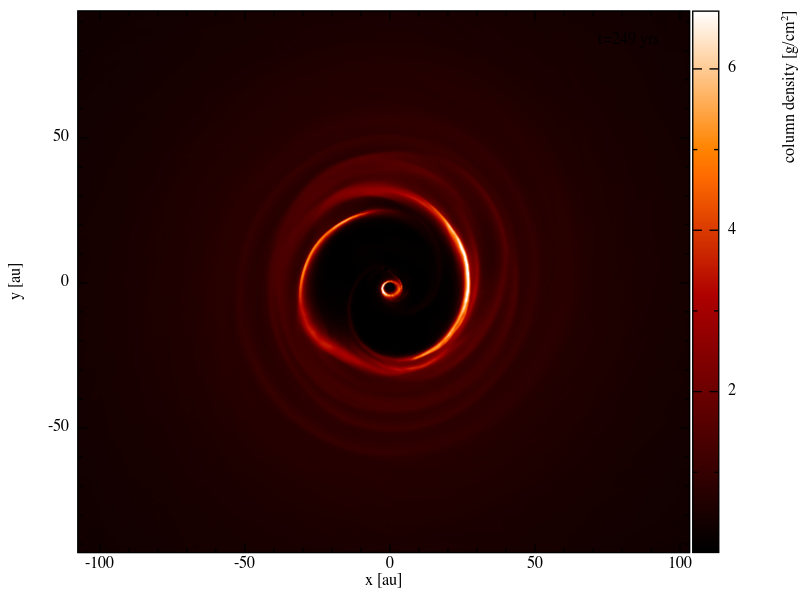
In the realm of computational astrophysics, researchers face a fundamental challenge: how do you visualize the invisible? When studying phenomena like stellar explosions, planetary formation, or galactic collisions, scientists rely on Smoothed Particle Hydrodynamics (SPH) simulations that represent matter as countless interacting particles. But raw particle data tells no story to the human eye—it’s just dots in space, hiding the cosmic drama unfolding within.
SPLASH bridges this gap with elegant mathematical precision, employing the same SPH smoothing kernels used in simulations to transform particle clouds into smooth, physically meaningful visualizations. Rather than plotting simple dots, it reconstructs continuous fields of density, temperature, and velocity, revealing shock waves rippling through stellar atmospheres or spiral arms forming in nascent galaxies. The tool reads data directly from simulation dumps, allowing researchers to step through cosmic time with single keystrokes, watching universes evolve in real-time. Beyond SPH data, SPLASH serves as a versatile plotting engine for any tabulated data, FITS images, or CSV files.
Developed primarily for astrophysics research, SPLASH has become an essential tool in computational astronomy labs worldwide. Its ability to produce publication-quality visualizations while maintaining interactive exploration makes it invaluable for both research discovery and scientific communication. Whether you’re modeling the collision of neutron stars or the formation of planetary systems, SPLASH transforms the abstract mathematics of hydrodynamics into the visual poetry of cosmic phenomena.
⭐ Stars: 67
💻 Language: Fortran
🔗 Repository: danieljprice/splash