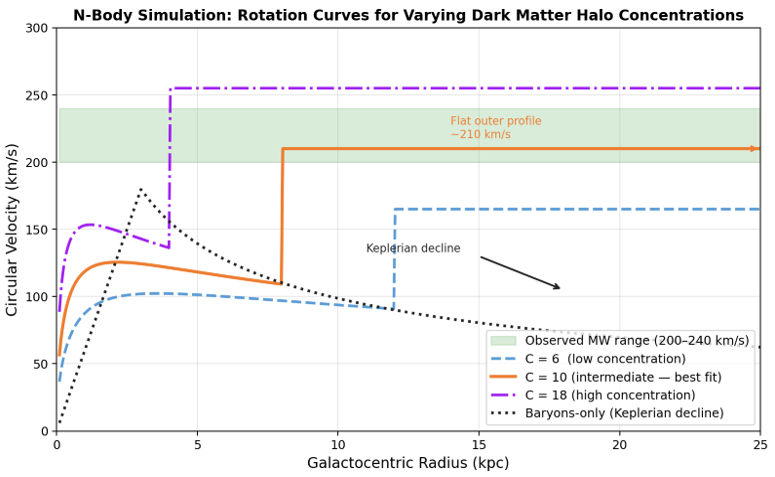
One of astronomy’s greatest mysteries lies hidden in the rotation curves of galaxies. Stars at the edges of spiral galaxies orbit far too quickly to be held by visible matter alone - they should be flung into the cosmic void. This repository tackles that enigma head-on, providing a complete simulation suite that tests the dark matter hypothesis through comparative modeling of galactic dynamics.
Built with performance-optimized C++ physics engines and interactive JavaScript visualizations, this toolkit simulates up to 10 million particles following realistic NFW (Navarro-Frenk-White) dark matter halo profiles. The simulations demonstrate that only intermediate concentration halos (C≈10) reproduce the flat rotation curves observed in our own Milky Way, while baryons-only models fail spectacularly with Keplerian decline. Complete with gravitational lensing demos, black hole particle interactions, and even a scaled Millennium Simulation, every component runs live in your browser.
What makes this particularly compelling is its accessibility - no installation barriers stand between researchers and cosmic insights. The included research paper validates the simulations against real observational data, making this both a educational playground and a serious research tool for understanding how dark matter shapes the universe’s largest structures.
⭐ Stars: 11
💻 Language: TeX
🔗 Repository: InsanityCore/Astrophysics-Simulations