Imagine combining the light from multiple telescopes spread across hundreds of meters to achieve resolution finer than the Hubble Space Telescope—that’s optical interferometry, and it’s revolutionizing how we see stars, exoplanets, and stellar phenomena. Arrays like CHARA, VLTI, and NPOI capture interference patterns that contain incredibly detailed information about celestial objects, but extracting that information requires sophisticated data processing that bridges optics, statistics, and computational astronomy.
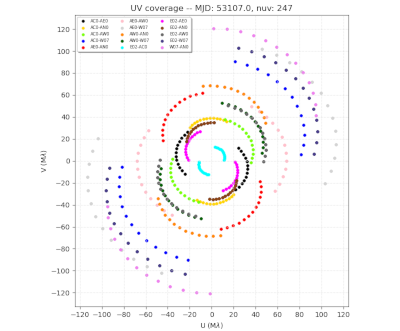
OITOLS.jl delivers a complete interferometry workflow in Julia, handling everything from raw OIFITS data ingestion to final image reconstruction. The package excels at both parametric model fitting (perfect for well-understood stellar phenomena) and direct image reconstruction (ideal for exploring unknown structures). It seamlessly processes complex visibilities, squared visibilities, closure phases, and correlation matrices, while offering intelligent data filtering, spectral binning, and visualization tools that make sense of UV-plane coverage and baseline configurations.
Developed by Prof. Fabien Baron at Georgia State University, this toolkit is actively used by interferometry researchers worldwide to study stellar surfaces, binary star orbits, circumstellar disks, and even exoplanet atmospheres. With Julia’s performance advantages and OITOOLS’ unified API for both imaging and modeling approaches, astronomers can iterate faster from observation to scientific insight, pushing the boundaries of what we can resolve in our cosmic neighborhood.
⭐ Stars: 11
💻 Language: Julia
🔗 Repository: fabienbaron/OITOOLS.jl