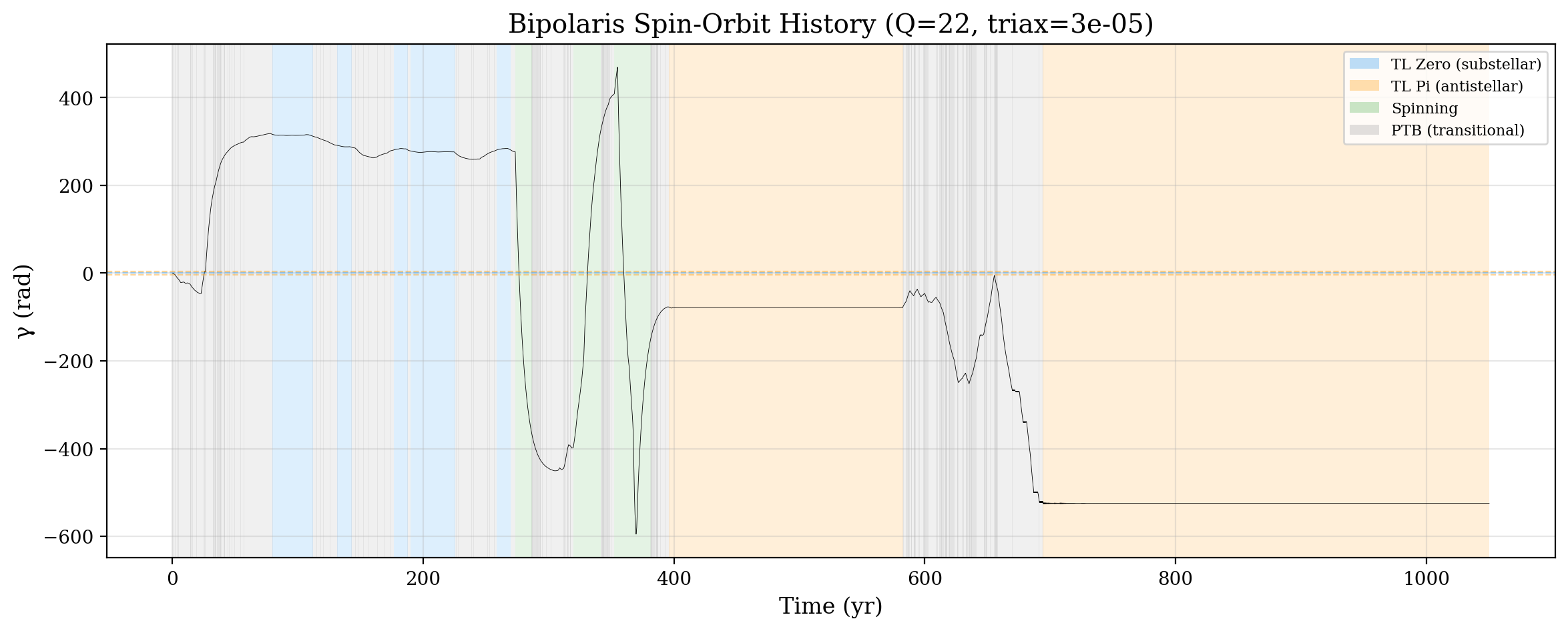
Picture a world locked in eternal day, with one face always blazing under its red dwarf star—until the delicate gravitational dance of its planetary neighbors breaks down. When resonant chains collapse, the resulting orbital chaos can cause tidally-locked planets to flip their orientation on decadal timescales, transforming hellish day-sides into frozen night-sides and back again. This phenomenon, known as True Longitudinal Spin Resonance (TLSR), represents one of the most dramatic examples of how planetary system architecture directly shapes surface conditions.
Stillspin brings this exotic physics to life through comprehensive Python simulations, implementing the Shakespeare & Steffen (2023) TLSR model with a focus on the fictional but realistic ‘Bipolaris’ system. The toolkit generates spin-orbit evolution histories, maps temperature profiles across flip-flop transitions, and performs sensitivity analysis across tidal quality factors and orbital parameters. Users can explore how secular perturbations from neighboring worlds create narrow ‘flip-flop zones’ where planets oscillate between locked states, spending decades in substellar lock before transitioning to antistellar orientations.
While currently a research exploration tool, the codebase offers valuable insights for exoplanet habitability studies and tidal dynamics research. The modular design makes it straightforward to adapt the simulations for different stellar systems, and the visualization pipeline helps researchers identify the surprisingly narrow parameter space where these dramatic transitions occur.
⭐ Stars: 3
💻 Language: Python
🔗 Repository: jonelay/stillspin