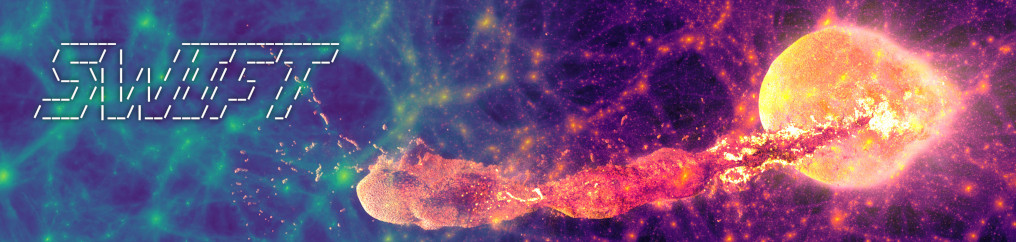
Imagine watching the universe unfold from the Big Bang to today, witnessing galaxies collide, stars form, and dark matter weave its invisible web across cosmic time. SWIFT makes this possible by tackling one of astrophysics’ most computationally demanding challenges: simulating the gravitational dance of billions of particles that represent everything from dark matter halos to gas clouds spanning millions of light-years.
Built for the petascale era, SWIFT combines Smoothed Particle Hydrodynamics (SPH) with sophisticated gravity solvers, scaling elegantly across tens of thousands of compute nodes through its innovative task-based parallelization. The code handles the complex physics of cosmic structure formation - tracking how primordial gas cools and fragments into the first stars, how supernova feedback shapes galactic evolution, and how dark matter scaffolding guides the cosmic web’s architecture. Its MPI-optimized engine can juggle gravitational N-body dynamics alongside hydrodynamical flows, making it a Swiss Army knife for computational cosmologists.
From modeling the Milky Way’s formation history to predicting how galaxy clusters will evolve over cosmic time, SWIFT powers cutting-edge research at observatories and universities worldwide. As next-generation telescopes like Euclid and the Vera Rubin Observatory prepare to map billions of galaxies, SWIFT provides the theoretical backbone to interpret these observations and test our understanding of dark matter, dark energy, and the fundamental processes that shaped our cosmic home.
⭐ Stars: 143
💻 Language: C
🔗 Repository: SWIFTSIM/SWIFT