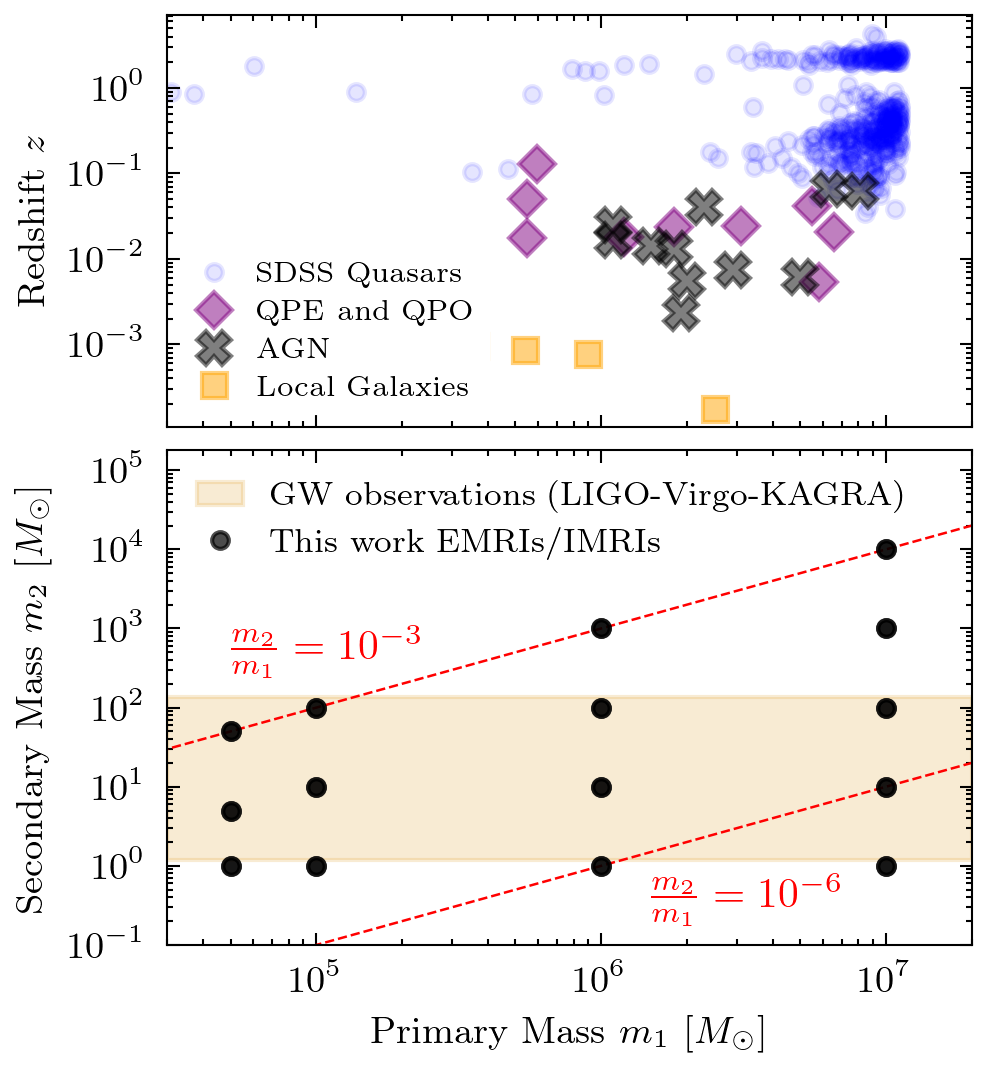
When a stellar-mass black hole spirals into a supermassive giant at the heart of a galaxy, it creates one of the universe’s most extraordinary phenomena: an Extreme Mass Ratio Inspiral (EMRI). These cosmic death spirals generate gravitational waves that carry pristine information about spacetime itself, but only if we can detect and decode them with sufficient precision. The upcoming LISA space mission will hunt for these signals, but how well can it actually perform across different scenarios?
This repository provides the computational machinery to answer that question quantitatively. Built around comprehensive Jupyter notebooks, it calculates Figures of Merit (FoMs) that reveal LISA’s detection capabilities across the full parameter space of EMRIs and their intermediate-mass cousins (IMRIs). The toolkit computes signal-to-noise ratios, parameter estimation precision, detection horizons, and the impact of mission constraints like duration and sensitivity degradation. Interactive visualizations let you explore how different black hole masses, spins, and orbital configurations affect detectability - from stellar remnants a few times our Sun’s mass to intermediate black holes thousands of times heavier.
Developed for the gravitational wave community, this tool serves mission planners optimizing LISA’s design, theorists predicting detection rates, and data analysts preparing for the flood of signals expected in the 2030s. The interactive Binder notebooks make complex calculations accessible without installation, while the modular Python framework allows researchers to adapt the analysis for their specific science cases.
⭐ Stars: 4
💻 Language: Jupyter Notebook
🔗 Repository: lorenzsp/EMRI-FoM