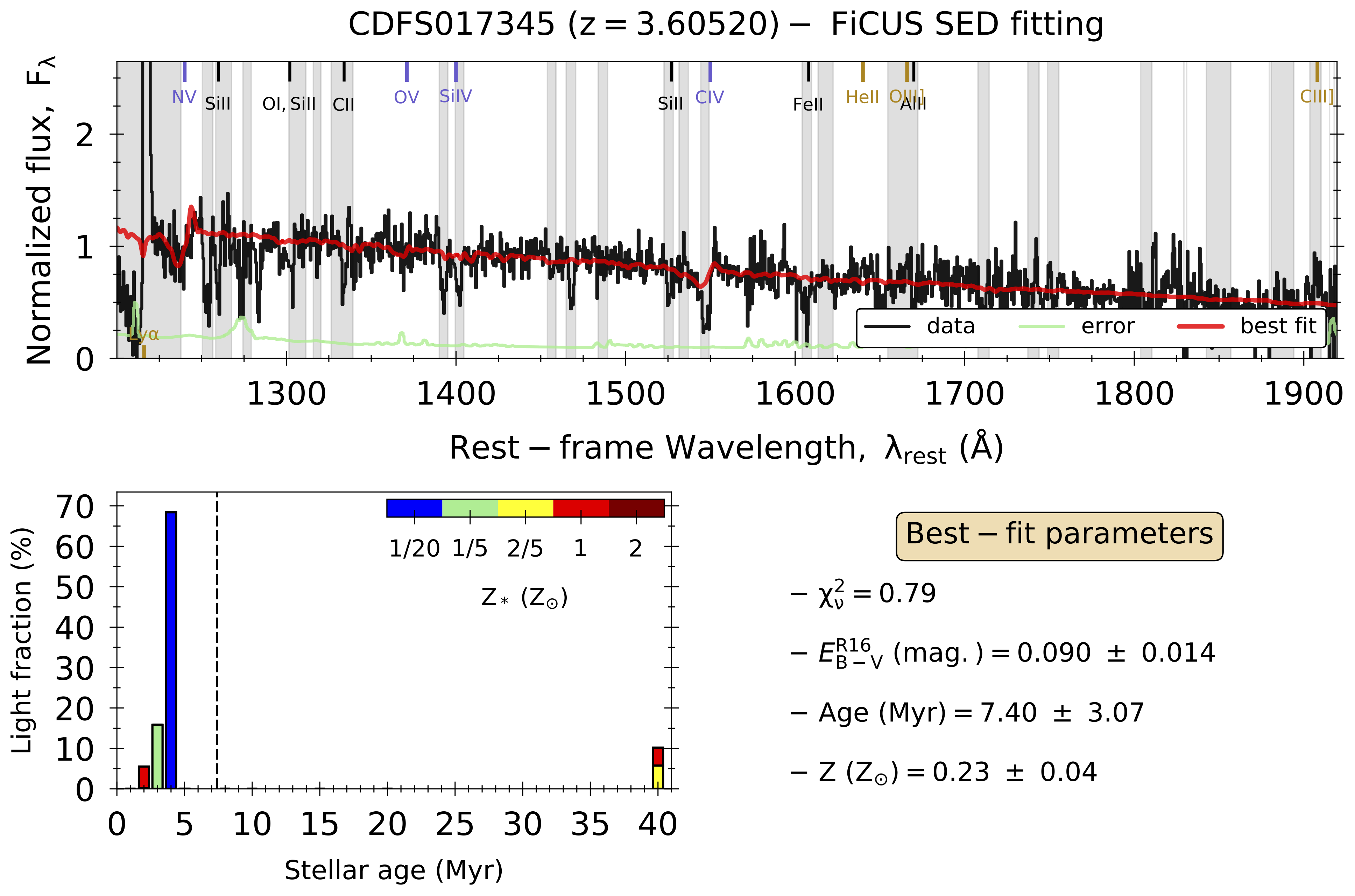
Every galaxy tells a story written in starlight, but the ultraviolet portion of that story has been notoriously difficult to decode. UV spectra capture the energetic signatures of young, massive stars and reveal crucial details about stellar populations, but extracting meaningful parameters from these complex observations requires sophisticated modeling techniques that can disentangle age, metallicity, and dust effects.
FiCUS tackles this challenge head-on by fitting observed UV spectra with linear combinations of stellar population synthesis models from Starburst99, BPASS, and stripped star models. The tool processes observed wavelength, flux density, and error data through a sophisticated pipeline that incorporates nebular continuum modeling via Cloudy and accounts for dust attenuation using a foreground slab geometry. It systematically explores parameter space across four metallicities (0.1 to 1 solar) and ten age bins (1-40 Myr) to extract fundamental galaxy properties including stellar age, metallicity, and extinction coefficients.
Originally developed for extragalactic research and tested on datasets described in Chisholm et al. 2019, FiCUS represents a specialized but powerful addition to the astronomer’s toolkit. Its ability to automatically fit stellar continua makes it invaluable for large spectroscopic surveys studying galaxy evolution, star formation histories, and the interstellar medium in UV-bright systems across cosmic time.
⭐ Stars: 10
💻 Language: Python
🔗 Repository: asalda/FiCUS