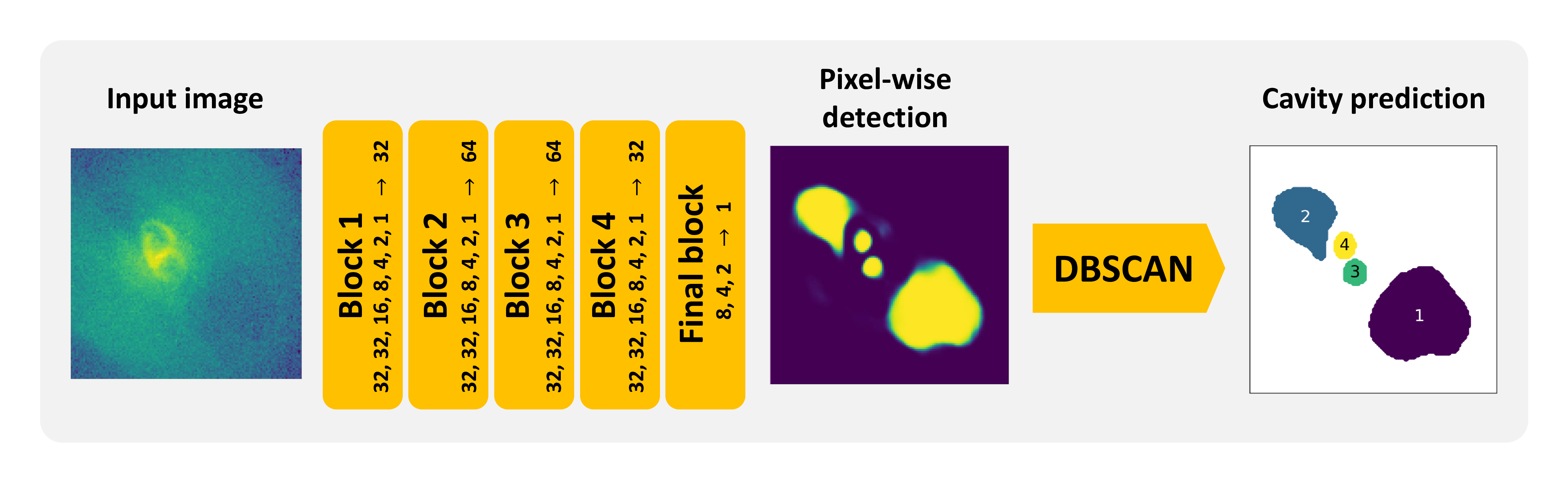
Deep within galaxy clusters, supermassive black holes carve out enormous cavities in the hot X-ray emitting gas—cosmic bubbles that can span hundreds of thousands of light-years. These X-ray cavities are crucial signatures of Active Galactic Nucleus (AGN) feedback, the process by which black holes regulate star formation across cosmic scales. But detecting these subtle surface brightness depressions in noisy Chandra X-ray Observatory images has been a painstaking manual task for astronomers.
CADET (Cavity Detection Tool) transforms this process with a sophisticated machine learning pipeline built on convolutional neural networks. The system uses a 5-layer CNN architecture inspired by Inception networks, implemented in Keras with support for TensorFlow, PyTorch, or JAX backends. It performs pixel-wise cavity predictions on Chandra images, then employs DBSCAN clustering to decompose these predictions into individual cavity detections. The tool comes as both a standalone Python package and a SAOImageDS9 plugin, making it accessible whether you prefer scripting or interactive analysis.
Published in MNRAS and trained on early-type galaxies and galaxy clusters, CADET opens new possibilities for large-scale surveys of AGN feedback. As X-ray archives grow and new missions like Athena approach, automated cavity detection will be essential for understanding how black holes shape the cosmic web. The tool’s multi-backend support and integration with standard astronomical software makes it ready for the next generation of X-ray astronomy.
⭐ Stars: 9
💻 Language: Jupyter Notebook
🔗 Repository: tomasplsek/CADET