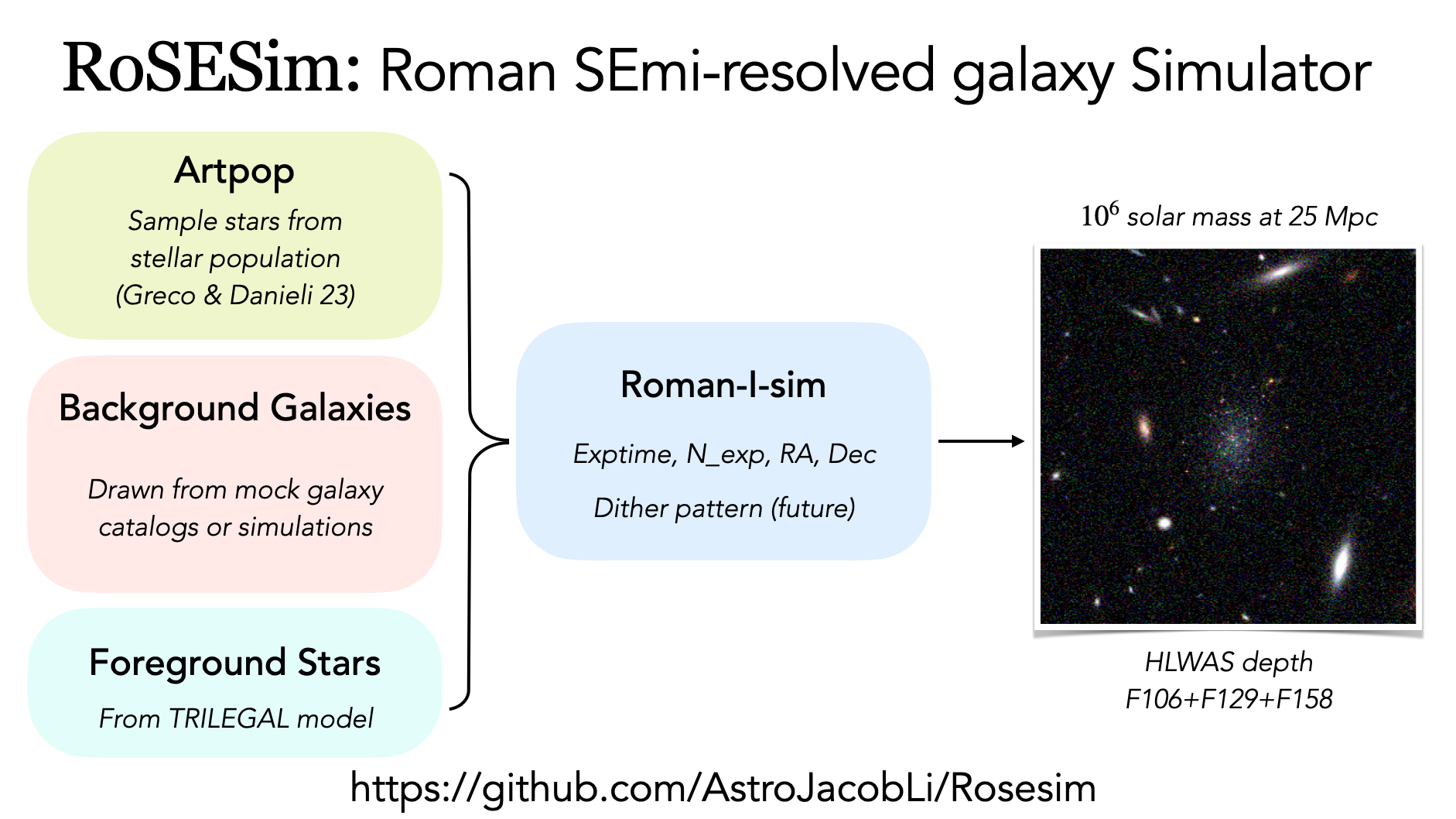
The Nancy Grace Roman Space Telescope promises to revolutionize our understanding of dwarf galaxies—the universe’s most abundant yet enigmatic stellar systems. But preparing for this cosmic census requires sophisticated simulations that can predict exactly what Roman will see when it peers into the depths of space, resolving individual stars in these distant galactic neighbors.
RoSE-Sim (Roman Semi-resolved Galaxy Simulator) tackles this challenge head-on by creating realistic synthetic images of dwarf galaxies as they’ll appear through Roman’s instruments. Built on PARSEC isochrones and integrated with custom versions of romanisim and ArtPop, it handles everything from stellar population synthesis to instrument-specific noise modeling. The simulator accounts for Roman’s unique characteristics—Vega magnitude photometry, specific filter responses, and observational constraints—while providing tools for zeropoint conversion and comprehensive testing frameworks.
This isn’t just academic preparation; it’s mission-critical infrastructure. As Roman approaches launch, astronomers worldwide will rely on tools like RoSE-Sim to design observing strategies, test analysis pipelines, and calibrate expectations for discoveries that could reshape our understanding of galaxy formation and dark matter. Whether you’re planning Roman observations or developing analysis software, this simulator offers a window into the future of galactic archaeology.
⭐ Stars: 3
💻 Language: Jupyter Notebook
🔗 Repository: AstroJacobLi/Rosesim