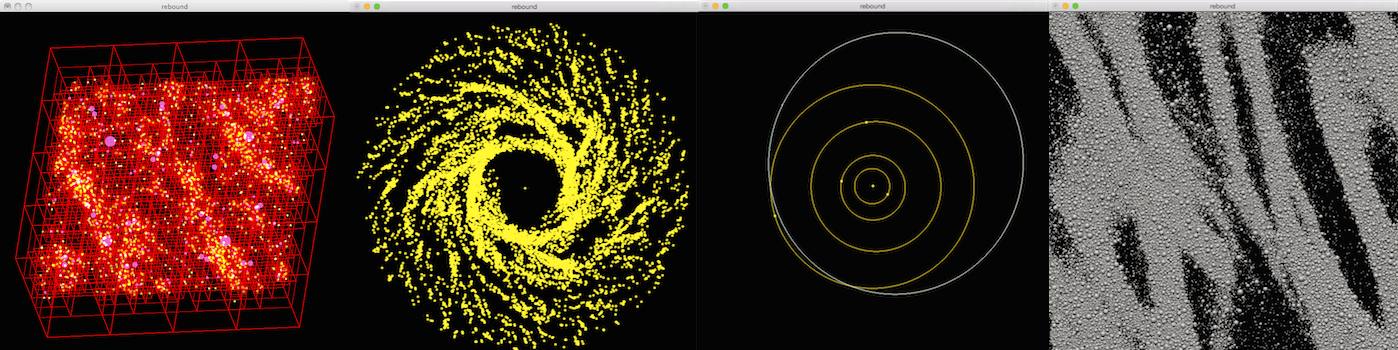
Imagine trying to predict where Jupiter will be in a million years, or whether that newly discovered exoplanet will survive its star’s violent youth. These are fundamentally N-body problems – cosmic choreographies where every particle influences every other through gravity’s invisible threads. REBOUND transforms these impossibly complex calculations into tractable code, giving astronomers the power to fast-forward through cosmic time and witness the universe’s grandest performances.
At its core, REBOUND is a gravitational dynamics powerhouse packed with an arsenal of integration methods. Its symplectic integrators like WHFast preserve energy over astronomical timescales, while the hybrid MERCURIUS handles close planetary encounters without breaking a sweat. Need to model Saturn’s rings colliding grain by grain? The collisional dynamics engine has you covered. Want to couple tidal forces with orbital mechanics? The arbitrary ODE integration seamlessly weaves additional physics into gravitational evolution. With no external dependencies and native cross-platform support, it runs everywhere from laptops to supercomputers.
From modeling the chaotic dynamics of asteroid families to predicting the long-term stability of multi-planet systems, REBOUND has become the go-to tool for researchers worldwide. Its extensive Python bindings make it accessible to the broader scientific community, while its C core delivers the performance needed for production-scale simulations. Whether you’re investigating planetary formation, designing space missions, or exploring the fate of stellar systems, REBOUND provides the computational telescope to peer deep into gravitational futures.
⭐ Stars: 1033
💻 Language: C
🔗 Repository: hannorein/rebound