When massive stars collapse or neutron stars collide, they unleash gamma-ray bursts—the most energetic explosions in the universe since the Big Bang. These cosmic cataclysms produce complex afterglows that fade across multiple wavelengths over days to years, carrying crucial information about jet physics, shock dynamics, and the fundamental processes governing extreme matter. Modeling these intricate light curves has traditionally been computationally expensive, limiting real-time analysis during critical follow-up observations of gravitational wave events.
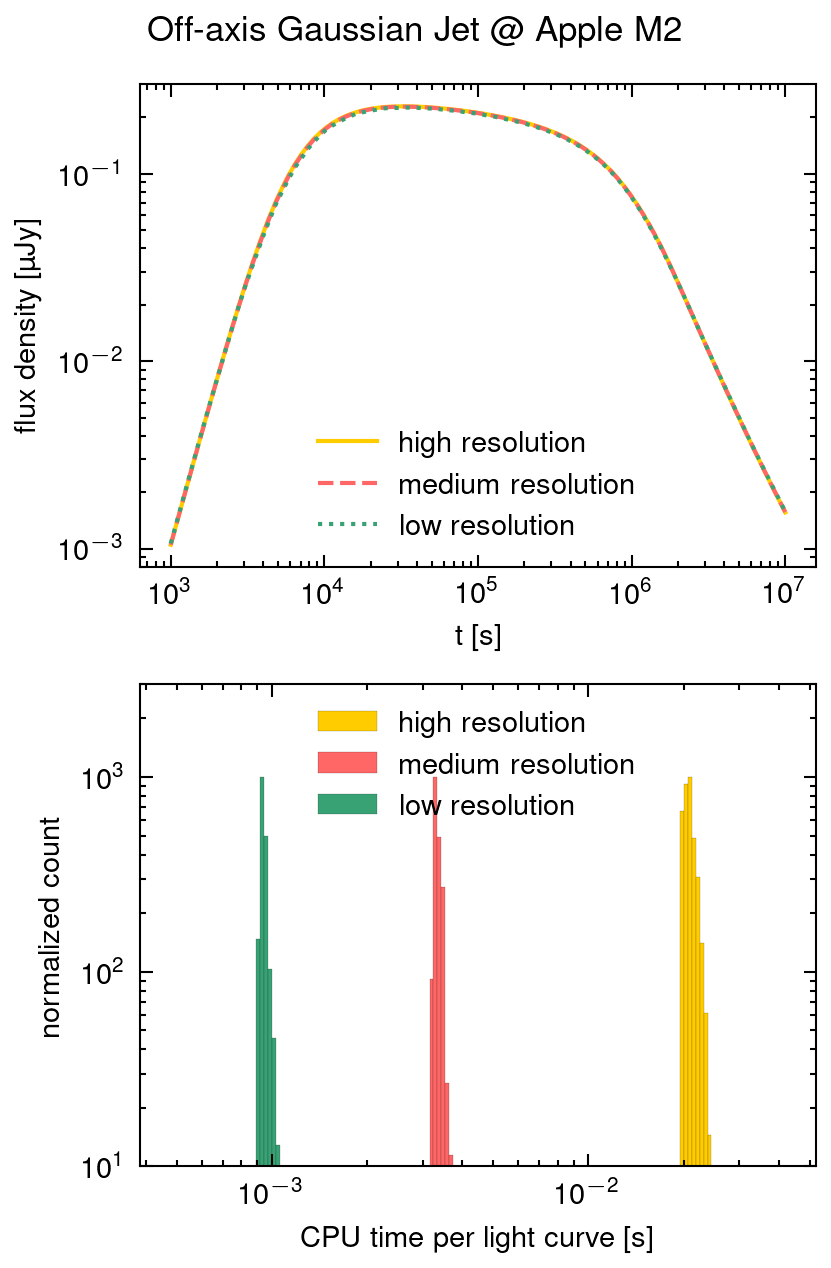
VegasAfterglow revolutionizes this landscape with a high-performance C++ core that generates multi-wavelength light curves in milliseconds rather than minutes. The framework incorporates sophisticated physics models including forward and reverse shock dynamics, synchrotron radiation with self-absorption, inverse Compton scattering with Klein-Nishina corrections, and structured jet configurations. Its Python bindings provide seamless integration into scientific workflows, while built-in MCMC capabilities enable robust parameter inference for constraining burst energetics, ambient medium properties, and jet opening angles.
With 36 stars and growing adoption in the multi-messenger astronomy community, VegasAfterglow is already integrated into advanced Bayesian inference frameworks like Redback. As LIGO-Virgo-KAGRA gravitational wave detections increase and next-generation telescopes like the Vera Rubin Observatory come online, this tool positions researchers to rapidly analyze the electromagnetic counterparts that reveal the physics of our universe’s most extreme events.
⭐ Stars: 36
💻 Language: C++
🔗 Repository: YihanWangAstro/VegasAfterglow