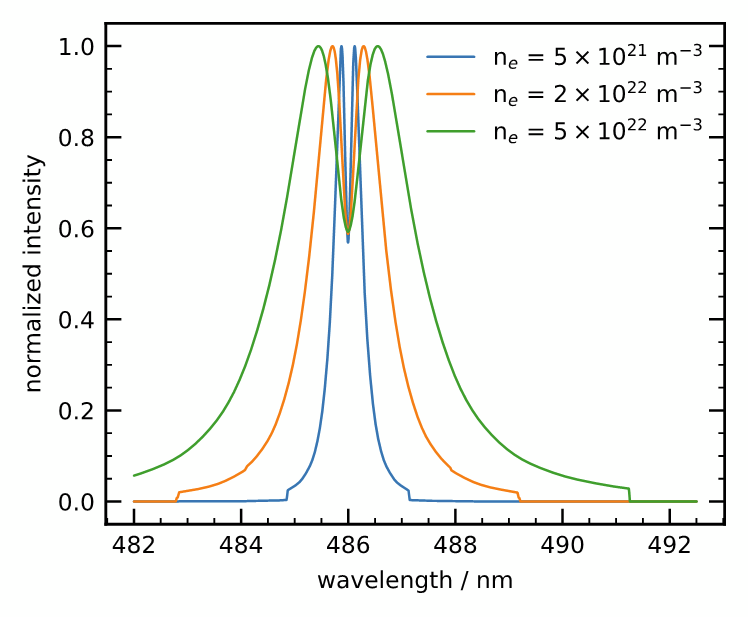
Every photon tells a story. When atoms in stellar atmospheres, planetary nebulae, or laboratory plasmas emit light, they create unique spectroscopic fingerprints that reveal temperature, density, and composition. But translating these emission lines into meaningful spectra requires sophisticated understanding of atomic physics, line broadening mechanisms, and complex databases. The OWL spectroscopic library turns this challenge into an elegant Python workflow, making advanced spectral analysis accessible to researchers worldwide.
At its core, OWL bridges the gap between NIST’s comprehensive atomic databases and practical spectroscopic analysis. It automatically fetches transition data and energy levels via astroquery, calculates sophisticated line broadening effects including Stark profiles for hydrogen Balmer series and helium lines, and generates complete PLTE (Plasma in Local Thermodynamic Equilibrium) spectra. The library handles the intricate physics of emission line shapes while providing clean, intuitive interfaces for accessing Einstein coefficients, energy levels, and Landé g-factors. Special attention to hydrogen Stark broadening using Gigosos profiles ensures accuracy for the most commonly observed stellar and plasma diagnostics.
Whether you’re analyzing stellar spectra, characterizing laboratory plasmas, or developing new diagnostic techniques, OWL transforms complex atomic physics into straightforward Python commands. From graduate students learning spectroscopy to seasoned researchers developing novel plasma diagnostics, this library democratizes access to professional-grade spectroscopic modeling tools.
⭐ Stars: 3
💻 Language: Python
🔗 Repository: Julian-Held/owl