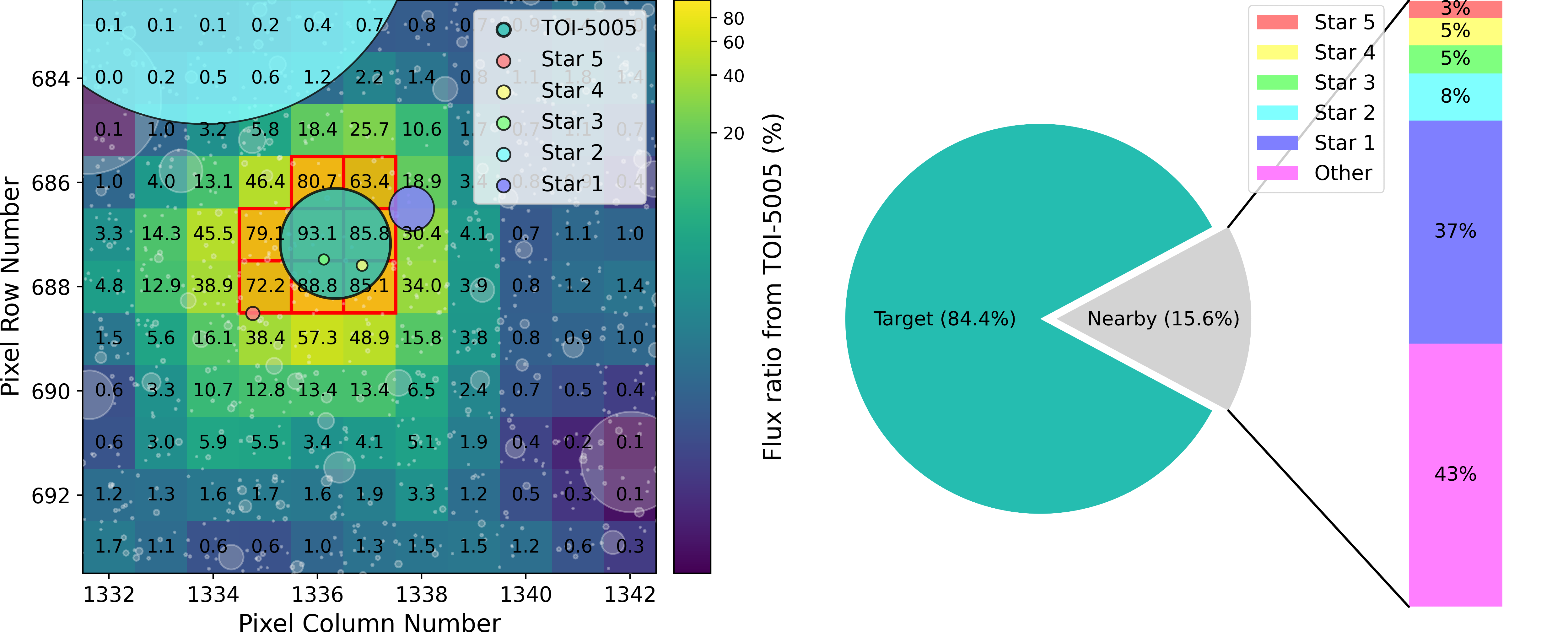
When hunting for exoplanets in TESS data, not all signals are what they seem. That mysterious transit dip might not be coming from your target star at all—it could be contamination from a nearby stellar neighbor bleeding flux into the photometric aperture. This deceptive phenomenon has fooled astronomers before, turning exciting planet candidates into frustrating false positives.
TESS-cont tackles this challenge head-on by building detailed Point Response Functions (PRFs) for nearby Gaia sources and mapping their flux contributions across TESS Target Pixel Files. The tool generates compelling visualizations: heatmaps showing exactly what percentage of flux comes from your target star versus contaminants, and pie charts revealing the most problematic nearby sources. With just a TIC or TOI number, researchers can identify which stars are polluting their photometry and determine whether transit or activity signals originate from impostor sources.
This Python toolkit has already proven its worth in peer-reviewed research, offering both command-line simplicity and Jupyter notebook flexibility. Whether you’re validating planet candidates, cleaning photometric data, or investigating stellar activity, TESS-cont transforms the tedious process of contamination analysis into an elegant, automated workflow that keeps your exoplanet science grounded in reality.
⭐ Stars: 8
💻 Language: Jupyter Notebook
🔗 Repository: castro-gzlz/TESS-cont