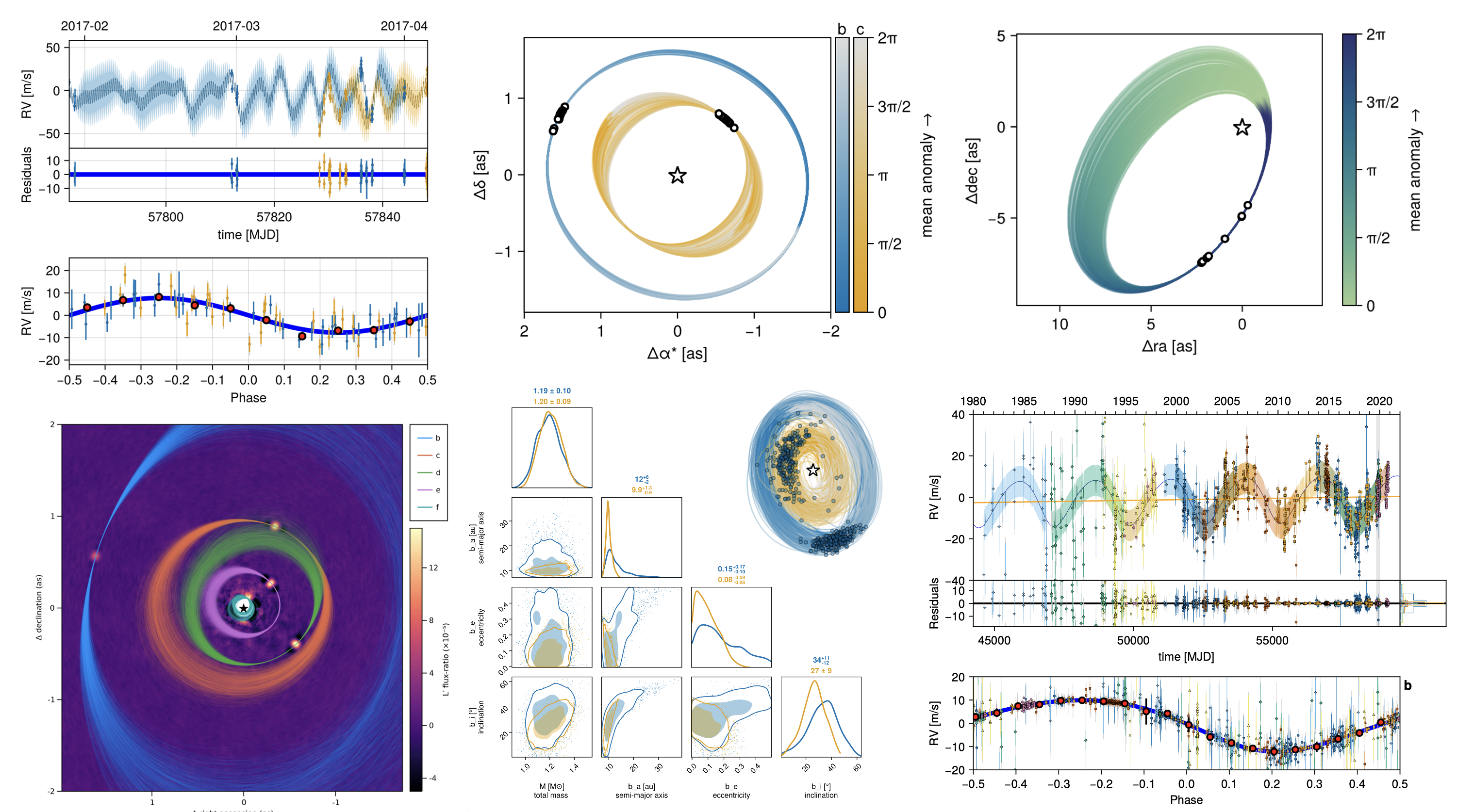
Every photon that reaches our telescopes carries secrets about distant worlds and stellar companions, but extracting meaningful orbital parameters from noisy observations has long challenged astronomers. Traditional fitting methods often struggle with the complex, multi-dimensional parameter spaces that characterize exoplanetary systems and binary stars, where masses, orbital periods, eccentricities, and inclinations interweave in mathematically elegant but computationally demanding ways.
Octofitter.jl transforms this challenge into an opportunity by harnessing Bayesian inference to simultaneously analyze radial velocity curves, astrometric measurements, direct imaging data, and even Gaia parallaxes. Built in Julia for maximum computational efficiency, it employs Hamiltonian Monte Carlo sampling to explore parameter spaces that would confound traditional optimization approaches. The package seamlessly integrates with established astronomical databases, automatically retrieving HARPS radial velocity data while implementing sophisticated priors like the O’Neil et al. observable-based constraints that reflect our physical understanding of planetary systems.
From characterizing newly discovered exoplanets to refining the orbits of visual binary stars, Octofitter.jl has already contributed to peer-reviewed discoveries published in the Astronomical Journal. Its elegant plotting capabilities, powered by Makie.jl, transform complex posterior distributions into publication-ready visualizations that reveal the subtle correlations between orbital parameters. Whether you’re a graduate student analyzing your first radial velocity dataset or a seasoned astronomer modeling complex multi-planet systems, this tool bridges the gap between raw astronomical data and the fundamental physical properties that define worlds beyond our solar system.
⭐ Stars: 44
💻 Language: Julia
🔗 Repository: sefffal/Octofitter.jl